
20 Different Ways to Say I’m Sorry in English
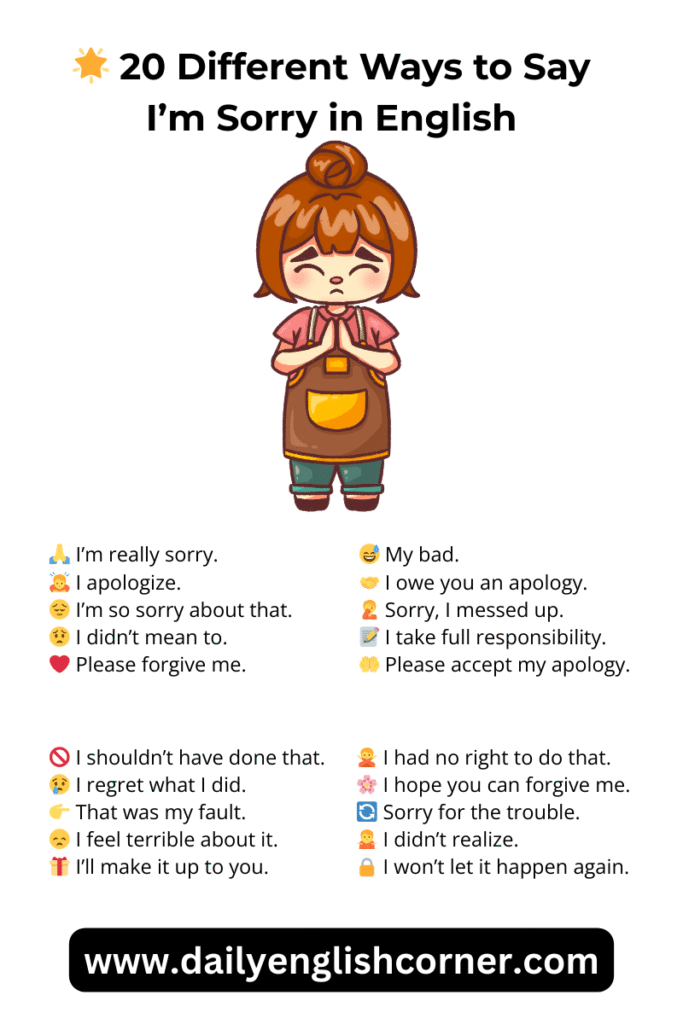
There are many natural ways to say I’m sorry in English, and choosing the right phrase depends on the situation. Sometimes you need a polite, formal apology, and other times a casual, friendly “sorry” works best.
We all make mistakes — forgetting a meeting, bumping into someone, or even saying something we didn’t mean. In English, simply saying “I’m sorry” works, but if you use the same phrase every time, it may sound repetitive. The good news? There are many different ways to say I’m sorry in English, depending on the situation.
In this post, we’ll explore 20 natural and polite alternatives to “I’m sorry,” so you can sound more fluent, sincere, and confident.
20 Ways to Say I’m Sorry in English
1. I apologize
A more formal version of “sorry,” often used in professional settings.
👉 Example: “I apologize for the delay in sending the report.”
2. My apologies
Polite and concise — great for emails or business communication.
👉 Example: “My apologies for the late reply.”
3. I’m so sorry
Adds extra emphasis, showing sincerity.
👉 Example: “I’m so sorry I missed your call.”
4. I’m terribly sorry
Stronger than “I’m sorry,” often used for serious mistakes.
👉 Example: “I’m terribly sorry for any inconvenience caused.”
5. Please forgive me
A heartfelt way of asking for forgiveness.
👉 Example: “Please forgive me for forgetting your birthday.”
6. I owe you an apology
Good for admitting fault directly.
👉 Example: “I owe you an apology for being rude yesterday.”
7. Sorry about that
Casual, often used for small mistakes.
👉 Example: “Oops! Sorry about that, I didn’t see you there.”
8. I’m sorry for the misunderstanding
Useful when clearing up confusion.
👉 Example: “I’m sorry for the misunderstanding earlier.”
9. Sorry for the inconvenience
Often used in customer service.
👉 Example: “Sorry for the inconvenience, we’re working on the issue.”
10. My bad
Very informal — common in casual conversations.
👉 Example: “Oh, that was my bad. I’ll fix it.”
11. I regret that
A polite way to show you feel sorry.
👉 Example: “I regret that I wasn’t able to attend your event.”
12. I shouldn’t have…
Shows responsibility for an action.
👉 Example: “I shouldn’t have spoken to you that way.”
13. I didn’t mean to…
Good for unintentional mistakes.
👉 Example: “I didn’t mean to hurt your feelings.”
14. Sorry, my mistake
Admitting fault in a direct but casual way.
👉 Example: “Sorry, my mistake — I gave you the wrong number.”
15. Pardon me
Polite and slightly formal, often used when bumping into someone.
👉 Example: “Pardon me, I didn’t see you there.”
16. Excuse me
Can mean both “sorry” and “please let me pass.”
👉 Example: “Excuse me, I didn’t mean to interrupt.”
17. I was wrong
Very direct and sincere.
👉 Example: “I was wrong about what I said yesterday.”
18. I shouldn’t have said that
Good for apologizing after harsh words.
👉 Example: “I shouldn’t have said that — I didn’t mean it.”
19. I feel bad about…
Shows regret and empathy.
👉 Example: “I feel bad about missing your presentation.”
20. I’ll make it up to you
Not only apologizing but also offering to fix the mistake.
👉 Example: “I’ll make it up to you by treating you to dinner.”
When to Use Different Apologies
- Formal situations (work, emails, meetings): I apologize, my apologies, I regret that.
- Casual situations (friends, daily life): Sorry about that, my bad, excuse me.
- Serious mistakes (when you’ve hurt someone): Please forgive me, I was wrong, I’ll make it up to you.
FAQs About Ways to Say I’m Sorry in English
❓ What is the most formal way to say I’m sorry?
The most formal options are “I apologize” and “My apologies”, often used in business or official settings.
❓ Can I use “my bad” in professional emails?
No, “my bad” is very informal. Use “I apologize” instead for professional communication.
❓ What’s a polite way to say sorry to a friend?
Phrases like “Sorry about that” or “I didn’t mean to…” are friendly and natural for casual situations.
If you’re planning a trip, don’t forget that learning polite apologies is just as useful as learning travel vocabulary. You might also enjoy our guide on 40 Useful English Phrases for Travelling Abroad, which will help you handle conversations confidently during your journeys.
✅ Key Takeaway
There are many ways to say I’m sorry in English, from formal to casual. Choosing the right phrase depends on the situation and how serious the mistake is.
👉 Next time you need to apologize, try using one of these expressions instead of the same old “sorry.” It will make you sound more natural and thoughtful in English.