
10 Common Mistakes English Learners Make in Spoken English – and How to Fix Them
Learning spoken English is a journey filled with excitement, small victories, and yes – a few mistakes along the way. These mistakes are completely normal. In fact, learners from every country tend to make very similar errors because spoken English doesn’t always follow the same patterns as textbook English.
The good news?
Once you know these mistakes and understand why they happen, you can avoid them easily. In this guide, we’ll explore the 10 most common spoken English mistakes learners make and give you simple, practical ways to fix them – with examples you can start using today.
Let’s begin!
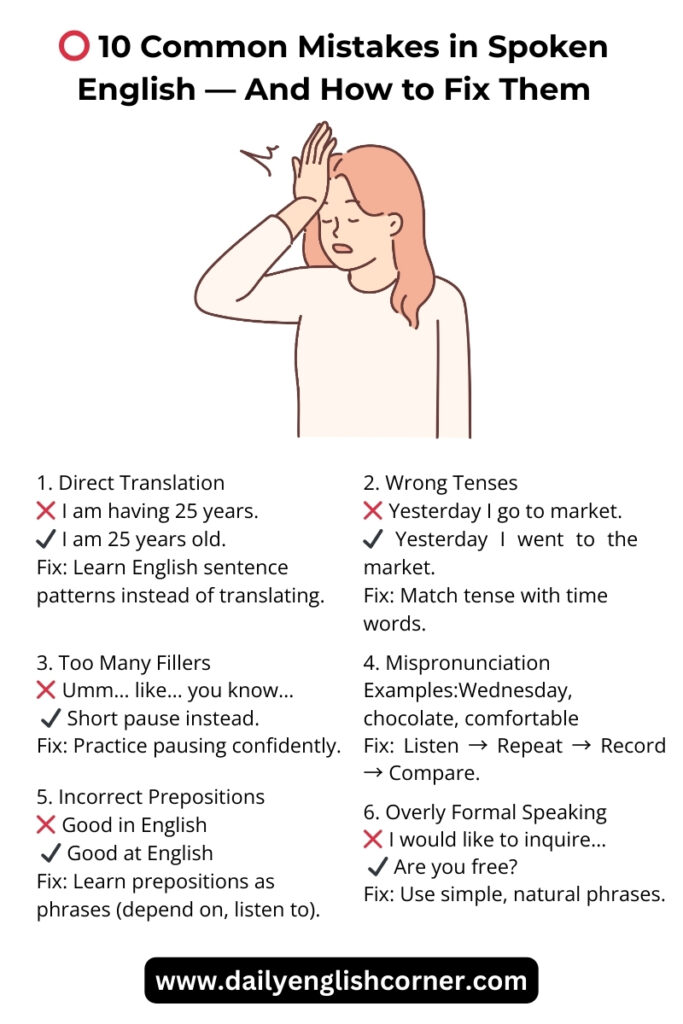
1. Translating Directly From Your Native Language
One of the biggest spoken English mistakes is translating sentences word-for-word from your mother tongue.
❌ Wrong:
- I am having 25 years.
- Open the light.
- She is more tall than me.
✅Correct:
- I am 25 years old.
- Turn on the light.
- She is taller than me.
Why it happens
Different languages have different grammar structures. What sounds natural in one language may sound strange in English.
How to fix it
Instead of memorizing English translations, focus on English patterns:
- Subject + Verb + Object
- Adjective + Noun
- Verb + Preposition (look at, listen to, talk about, etc.)
Practice short, everyday sentences until they feel natural.
2. Using the Wrong Tense in Conversations
Many learners switch between past, present, and future without realizing it.
❌ Wrong:
- Yesterday I go to the market and buy vegetables.
✅ Correct:
- Yesterday I went to the market and bought vegetables.
Why it happens
When speaking fast, learners focus on meaning, not grammar.
How to fix it
Start paying attention to time words:
- yesterday → past tense
- now → present tense
- tomorrow → future tense
Speak a little slower and give yourself time to form the correct tense.
3. Using Too Many Fillers (“Umm…”, “Like…”, “You know…”)
Fillers are natural — even native speakers use them.
But too many fillers make you sound unsure or nervous.
❌ Example:
- Umm… I like… you know… to watch… like… movies.
✅ Better:
- I enjoy watching movies.
How to fix it
Use a short pause instead of a filler.
A calm 1-second pause actually makes you sound more confident.
4. Mispronouncing Difficult Words
Spoken English mistakes often come from pronunciation, especially with words that don’t sound the way they’re spelled.
Commonly mispronounced words:
- Wednesday → wenz-day
- Comfortable → kumf-tuh-bl
- Clothes → kloz
- Chocolate → chaw-klit
- Fruit → froot (not froot-uh)
How to fix it
- Listen to native audio (YouTube, podcasts, audiobooks).
- Repeat the same word 10–15 times.
- Record yourself and compare the sound.
Pronunciation improves faster when you hear yourself.
5. Using the Wrong Prepositions
Prepositions are one of the trickiest parts of spoken English.
❌ Wrong:
- He is good in English.
- I will meet you on next week.
- She is married with an engineer.
✅ Correct:
- He is good at English.
- I will meet you next week.
- She is married to an engineer.
How to fix it
Learn prepositions as phrases, not rules:
- depend on
- listen to
- belong to
- interested in
- excited about
The more you use them, the easier they become.
6. Speaking in Overly Formal English
Many learners sound too “textbook-like” when speaking:
❌ Example:
- I would like to inquire about your availability.
✅ Natural English:
- Are you free?
- Do you have time?
Spoken English should be simple, direct, and friendly.
How to fix it
Use everyday phrases:
- I’m not sure.
- That sounds good.
- Let’s do it.
- I’ll get back to you.
Speak how people talk — not how books speak.
7. Using the Wrong Word for the Situation
This happens when you know the word but not the correct context.
❌ Wrong:
- I am boring. (meaning: I am a boring person)
✅ Correct:
- I am bored.
(MEANING: I feel bored right now)
More common confusions:
- funny (makes you laugh) vs fun (enjoyable)
- hungry vs angry vs hangry
- lose (not win) vs loose (not tight)
How to fix it
Learn vocabulary with:
✔ examples
✔ context
✔ real-life conversation
✔ emotional meaning
This helps your “word sense” improve naturally.
8. Using Double Comparatives
Learners sometimes try to add two comparative markers.
❌ Wrong:
- She is more prettier.
- This is more better.
✅ Correct:
- She is prettier.
- This is better.
Why it happens
In many languages, adding extra words makes the emphasis stronger.
But English uses one form only.
9. Forgetting Articles (A, An, The)
Articles are tiny words but they matter a lot.
❌ Wrong:
- I saw dog in park.
- She is going to office.
✅ Correct:
- I saw a dog in the park.
- She is going to the office.
How to fix it
Remember simple rules:
- a/an = any one thing
- the = a specific thing
- no article = places used for their purpose (school, bed, church)
Example:
My son is in school,
but
I am going to the school (to meet a teacher).
10. Ending Sentences With Rising Intonation (Sounding Like a Question)
Many learners unintentionally raise their voice at the end of a sentence.
❌ Sounds unsure:
- I live in Spain?
- I work in marketing?
✅ Confident tone:
- I live in Spain.
- I work in marketing.
How to fix it
Practice saying sentences with a falling tone:
⬇ I live here.
⬇ This is my friend.
⬇ I don’t understand.
Controlled intonation makes your speech clearer and more confident.
⭐ Bonus: What Actually Helps You Improve Quickly
Here are small habits that make a big difference:
1. Practice 10 minutes daily
Small, consistent practice beats long, irregular sessions.
2. Speak out loud (even when alone)
Your mouth needs practice just like muscles do.
3. Learn phrases, not words
Native speakers use chunks like:
“Do you wanna…?”
“I’m not sure if…”
4. Record yourself weekly
You’ll notice improvements you didn’t realize were happening.
5. Surround yourself with English
Switch your phone, watch interviews, listen to podcasts, read simple stories.
Conclusion
Making mistakes in spoken English is completely normal – it’s part of the learning process. What matters is that you recognize them, understand why they happen, and replace them with natural expressions.
If you focus on these 10 areas, your spoken English will become:
✔ smoother
✔ more natural
✔ more confident
✔ and much more enjoyable
You’re not just learning English – you’re learning to express yourself clearly and confidently. Keep going!
If you want to improve your everyday speaking, you may also like our guide on 👉 20 Different Ways to Say “I’m Sorry” in English – it helps you sound more natural and expressive in real conversations.