
25 Natural Ways to Say Goodbye in English (Formal & Informal)
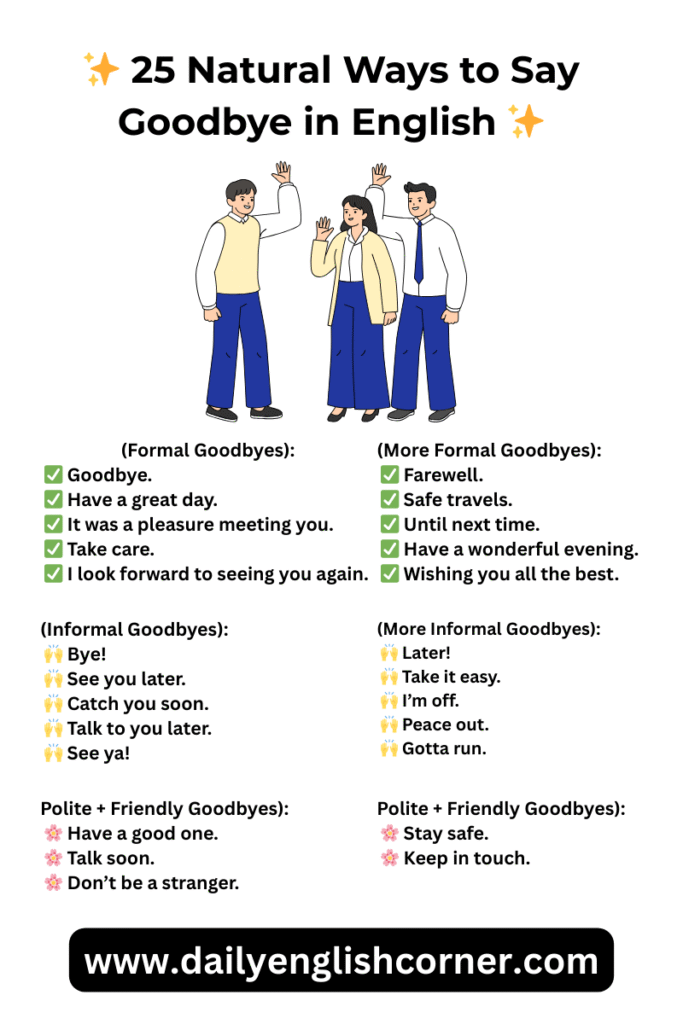
We all say “goodbye” many times a day. Sometimes it’s a quick “see ya,” and other times it’s a polite “have a great day.” The words we choose depend on who we’re talking to – a friend, a colleague, or even a stranger.
If you’ve been using only “goodbye” or “bye,” this post is for you. Here, we’ll explore 25 natural ways to say goodbye in English (both formal and informal), along with real-life examples so you can use them right away.
Formal Ways to Say Goodbye in English
When you’re in a professional setting, speaking to a teacher, or saying goodbye in a respectful way, try these expressions.
1. Goodbye
Simple and classic.
👉 Example: “Goodbye, Professor. See you next week.”
2. Farewell
More traditional, used in formal speeches or writing.
👉 Example: “Farewell, and best wishes for your journey.”
3. Take care
Shows concern and warmth.
👉 Example: “Take care, Mr. Smith. Drive safely.”
4. Have a great day
Polite and uplifting.
👉 Example: “Thank you for your time. Have a great day!”
5. It was a pleasure meeting you
Perfect after meeting someone new.
👉 Example: “It was a pleasure meeting you. Let’s stay in touch.”
6. Until next time
Formal, but friendly.
👉 Example: “Until next time, I hope your project goes well.”
7. I look forward to seeing you again
Ideal for work or networking.
👉 Example: “I look forward to seeing you again at the conference.”
8. Have a safe trip
Used when someone is traveling.
👉 Example: “Have a safe trip back home!”
Informal Ways to Say Goodbye in English
For friends, family, and casual conversations, these phrases are more relaxed.
9. Bye
The simplest and most common.
👉 Example: “Bye! See you later.”
10. See ya
Casual and friendly.
👉 Example: “See ya at the party tonight!”
11. Later / Catch you later
Cool and informal.
👉 Example: “Catch you later, bro.”
12. Take it easy
Relaxed, friendly goodbye.
👉 Example: “Take it easy, man. Don’t stress too much.”
13. I’m off / I gotta go
Quick way to leave.
👉 Example: “I’m off now. Talk tomorrow.”
14. Talk to you soon
Shows you’ll reconnect soon.
👉 Example: “Talk to you soon! Call me later.”
15. See you tomorrow / next week
Good for fixed plans.
👉 Example: “See you tomorrow at work.”
16. Peace / Peace out
Very casual, used among friends.
👉 Example: “Peace out, guys!”
17. Catch ya on the flip side
Slangy and playful.
👉 Example: “Catch ya on the flip side, buddy.”
18. Smell ya later (joking)
Humorous goodbye.
👉 Example: “Okay, smell ya later!”
19. Bye-bye
Friendly and often used with kids.
👉 Example: “Bye-bye, sweetheart.”
20. Later, alligator (kids’ rhyme)
Playful and lighthearted.
👉 Example: “Later, alligator!” — “In a while, crocodile!”
💡 Related Reading: If you also want to improve how you express gratitude in English, check out our guide on 30 Polite Ways to Say Thank You in English.
Polite and Friendly Ways to Say Goodbyes
These work in both casual and polite settings.
21. Take care of yourself
👉 Example: “Take care of yourself. Don’t work too hard.”
22. Stay safe
👉 Example: “Stay safe during the storm.”
23. Keep in touch
👉 Example: “Keep in touch after you move.”
24. Don’t be a stranger
👉 Example: “Don’t be a stranger — come visit us soon.”
25. All the best
👉 Example: “All the best for your exams. Goodbye for now.”
✅ Key Takeaway
There are many ways to say goodbye in English. Some are formal like “farewell” or “until next time,” while others are informal like “see ya” or “catch you later.” The trick is choosing the right one for the situation.
❓ FAQ
Q1: What is the most polite way to say goodbye in English?
A: “It was a pleasure meeting you” or “I look forward to seeing you again” are very polite.
Q2: Can I use informal goodbyes in professional settings?
A: It’s better to stick with formal phrases in workplaces. Save casual ones for friends and family.
Q3: Which goodbye phrases are most common in daily English?
A: “Bye,” “See ya,” “Take care,” and “Talk to you soon” are widely used in everyday conversation.
🎯 Final Tip
Next time you’re about to leave a conversation, try a new phrase instead of the usual “bye.” It’ll make your English sound more natural and expressive.
👉 So, which goodbye phrase do you use most often?